What Is an Eco-Solvent Printer?
An eco-solvent printer is a wide-format inkjet printer that uses mild, petroleum-based inks to print on flexible media such as vinyl, canvas, banner material, and vehicle wrap film. Unlike traditional harsh-solvent printers, eco-solvent inks have significantly lower volatile organic compound (VOC) emissions, which means they can be used safely indoors without requiring industrial ventilation systems.
The term "eco-solvent" does not mean the ink is water-based or environmentally neutral — it simply means the solvent carrier is milder and less aggressive than full-solvent formulas. The ink still bonds permanently to most coated flexible substrates, giving prints excellent weather resistance and outdoor durability of 3–5 years unlaminated.
Definition: An eco-solvent printer is a large-format printing machine that uses low-VOC, solvent-based inks to produce durable, weather-resistant prints on vinyl, canvas, and other flexible media — ideal for outdoor signage, vehicle wraps, and wide-format graphics.
How Does an Eco-Solvent Printer Work?
Eco-solvent printers operate on the same principle as standard inkjet printers but at a much larger scale. Here is the process from media loading to finished output:
Roll media is loaded onto the take-up system. Pre-heat elements raise the media surface temperature to improve ink adhesion before the print zone.
The printhead carriage moves back and forth, firing microscopic ink droplets. Multiple passes (3-pass, 4-pass, 6-pass) build up layers — more passes mean higher quality and slower speed.
The solvent carrier evaporates, leaving the pigment permanently bonded to the media surface. Infrared heaters and fans accelerate this. Unlike UV printing, no curing lamp is needed.
The printed roll exits dry and ready for lamination, cutting, or application. High-quality eco-solvent output can last 3–5 years outdoors without laminate, and 5–7 years with protective overlay.
Eco-Solvent vs Solvent vs UV Printer: Which Is Right for You?
One of the most common questions before buying a wide-format printer: should I get an eco-solvent, solvent, or UV printer? Here is a direct side-by-side comparison.
| Feature | Eco-Solvent | Solvent | UV |
|---|---|---|---|
| Ink Type | Mild petroleum-based | Harsh petroleum-based | UV-reactive resin |
| VOC Emissions | Low — indoor safe | High — ventilation required | Very low |
| Best Media | Vinyl, canvas, banner, mesh | Vinyl, banner, mesh | Acrylic, glass, wood, PVC, leather |
| Rigid Substrates | No | No | Yes |
| Outdoor Durability | 3–5 years (unlaminated) | 5–7 years (unlaminated) | 2–4 years (flexible media) |
| Print Speed | Fast (mid-to-high) | Fast | Moderate |
| Ink Cost | Moderate | Low–Moderate | Higher |
| Curing Method | Heat + air drying | Heat + air drying | UV lamp (instant cure) |
| Best For | Vehicle wraps, banners, murals | Heavy outdoor signage | Promotional items, rigid signage |
Bottom line: If your business focuses on vehicle wraps, outdoor banners, and large murals, eco-solvent is the most versatile and cost-effective choice. If you need to print on hard surfaces like acrylic or glass, consider a UV flatbed printer instead.
What Can You Print With an Eco-Solvent Printer? (Use Cases)
Eco-solvent printers are versatile workhorses. Here are the primary commercial applications:
Vehicle Wraps
Eco-solvent ink bonds tightly to cast vinyl and calendered wrap film, delivering rich color with flexibility to contour around curves. The ink does not crack during application or in extreme heat.
Outdoor Banners & Signage
Standard frontlit and backlit vinyl banners, mesh banners for wind resistance, and PVC tarpaulin. Eco-solvent ink resists UV fading outdoors for 3–5 years without laminate.
Wall Murals & Interior Graphics
Wallpaper, canvas, and fabric substrates can be printed with photo-quality detail. Eco-solvent's low odor makes it safe for interior installation without extended off-gassing.
Floor Graphics
With laminate overlay, eco-solvent floor graphics are slip-resistant and durable for high-traffic retail environments — common in malls, exhibitions, and event venues.
Exhibition & Event Displays
Trade show backdrops, pop-up banners, roll-up stands, and booth graphics. See our promotional display guide for compatible display systems.
Packaging Mockups
Short-run packaging proofs on adhesive vinyl or synthetic paper for product photography and client approval — a growing segment for print shops serving FMCG brands.
Smart RJ24-2004 Eco-Solvent Printer Review: Real-World Performance
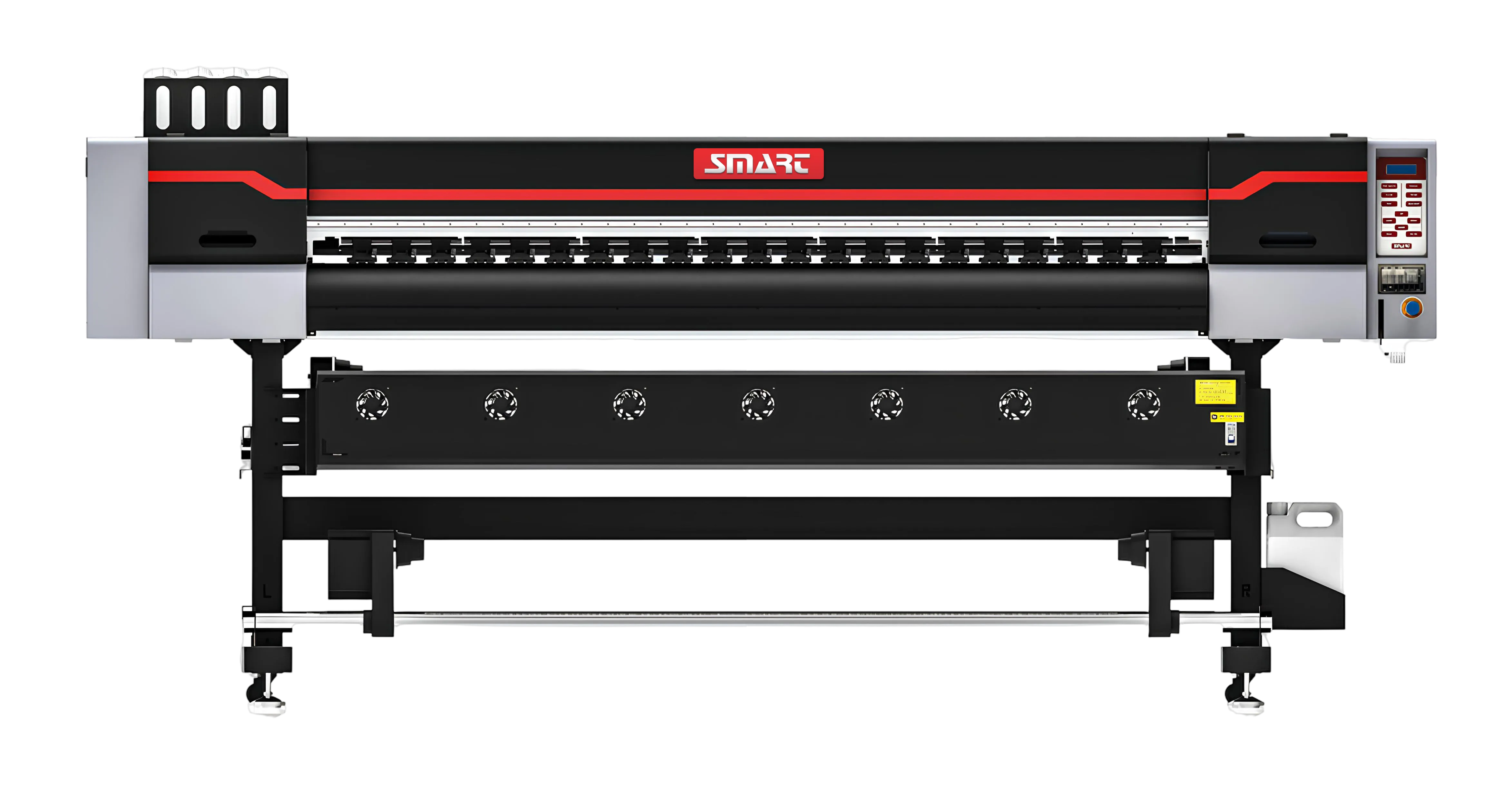
Now let us look at one of the strongest eco-solvent machines available in the Philippine market: the Smart RJ24-2004, distributed locally by Kelin Graphics System.
Technical Specifications
| Specification | RJ24-2002 | RJ24-2004 |
|---|---|---|
| Printhead | EPSON I3200 A1/E1 (Dual) | |
| Print Width | 1.9 m (75 inches) | |
| Speed — 3 Pass | 56 m²/h | 112 m²/h |
| Speed — 4 Pass | 39 m²/h | 77 m²/h |
| Speed — 6 Pass | 27 m²/h | 53 m²/h |
| Drying System | Pre & Post Infrared Heating + External Fan | |
| Guide Rail | THK Mute Guide Rail (Japan) | |
| Carriage Frame | Full Aluminum Alloy | |
| Machine Dimensions | 3700 × 750 × 850 mm | |
| Gross Weight | 314 kg | 348 kg |
| Power Supply | AC 220V / 50–60Hz | |
| RIP Software | Maintop 6 (included) | |
Real-World Print Performance
Averaged 71 m²/h sustained output. Zero banding across four consecutive full-car wrap sets. Excellent color accuracy with minimal profiling.
Approximately 98 m²/h sustained on 440g frontlit vinyl. Material came off the roll nearly dry — eliminating curl-and-jam issues.
Around 48 m²/h on 200g matte wallpaper. Exceptional shadow detail in photographic prints. Pre-heat prevented cockling on heavier stock.
Key Engineering Advantages
THK Mute Guide Rail (Japan)
The same precision rail used in CNC machine tools. Near-zero carriage vibration means sharper dot placement at high speeds.
Dual-Stage Infrared Drying
Pre-heat + post-heat + external infrared fan. Prints exit nearly dry, ready for lamination or cutting immediately after output.
High-Integration Control Board
Reduces signal path latency and electromagnetic interference — hidden causes of print artifacts at high speed.
Full Aluminum Alloy Frame
Better thermal stability than stamped steel. Zero positional drift measured across a 500 m² continuous run.
Smart RJ24-2004: Pros and Cons
Pros
- Genuine 112 m²/h speed — fastest in its price class for eco-solvent
- EPSON I3200 heads: sharp output, long service intervals, wide ink compatibility
- THK guide rail delivers near-silent, precision carriage movement
- Dual-stage drying — output is job-ready directly off the roll
- Aluminum alloy structure resists thermal drift during extended runs
- Maintop 6 RIP software included (₱30,000+ value)
- Local support via Kelin Philippines — parts and technicians without import delays
Cons
- At 314–348 kg, requires reinforced floor area and professional installation
- 1.9 m print width only — not suitable for shops needing 2.5 m or 3.2 m output
- Maintop 6 has a learning curve for operators new to professional RIP software
- External infrared fan adds airflow noise — plan shop ventilation accordingly
- Initial ink color profiling requires setup time; not plug-and-print ready
Eco-Solvent Printer Price in the Philippines: What to Expect
| Tier | Price Range | Typical Use |
|---|---|---|
| Entry-level (1.6m, DX5/DX7 head) | ₱150,000 – ₱300,000 | Small print shops, startups |
| Mid-range (1.8m, I3200 head) | ₱350,000 – ₱600,000 | Growing shops, vehicle wraps, signage |
| Industrial (1.9m, dual I3200, Smart RJ24) | ₱600,000 – ₱900,000 | High-volume production shops |
| Premium (2.5m–3.2m, multi-head) | ₱1,000,000+ | Large-format production, outdoor billboards |
For current pricing, contact Kelin Philippines directly for a quotation.
Frequently Asked Questions About Eco-Solvent Printers
What is an eco-solvent printer used for?
Eco-solvent printers are used for vehicle wraps, outdoor banners, wall murals, floor graphics, retail signage, canvas prints, exhibition displays, and window graphics. They work on most flexible roll media including vinyl, canvas, backlit film, and mesh.
Is eco-solvent printing safe indoors?
Yes. Unlike full-solvent printers, eco-solvent printers emit low VOC levels and can be operated safely in a ventilated room without industrial exhaust systems. Basic room ventilation is sufficient for most models.
How long do eco-solvent prints last outdoors?
Unlaminated eco-solvent prints typically last 3–5 years outdoors in direct sunlight. With a UV-protective laminate overlay, durability extends to 5–7 years.
What is the difference between eco-solvent and UV printing?
Eco-solvent ink dries through solvent evaporation and bonds to flexible media. UV ink cures instantly under ultraviolet light and can be applied to rigid substrates like acrylic, glass, wood, and metal. If you need to print on hard surfaces, a UV printer is the better choice.
What inks are compatible with the Smart RJ24?
The Smart RJ24-2004 uses EPSON I3200-compatible eco-solvent inks. Kelin Philippines stocks compatible inks including the Eagle V2 and Phoenix E2 series.
Is the Smart RJ24 the best eco-solvent printer for small businesses?
The Smart RJ24-2004 is best suited for established small-to-medium print shops with consistent daily production volume. For brand-new startups on a tight budget, an entry-level eco-solvent model may be a better starting point.
Explore Related Products and Guides
Looking for a wider format option? The XLINE offers 3.2m print width — ideal for billboard and large outdoor signage production.
Compare ink types — understand compatibility, cost per square meter, and color gamut differences.
Learn which media types are compatible with eco-solvent printing.
Maintain your eco-solvent printer with the right printhead cleaning solutions and replacement parts.