Why the IECHO BK3 Is Built for Production, Not Just Cutting
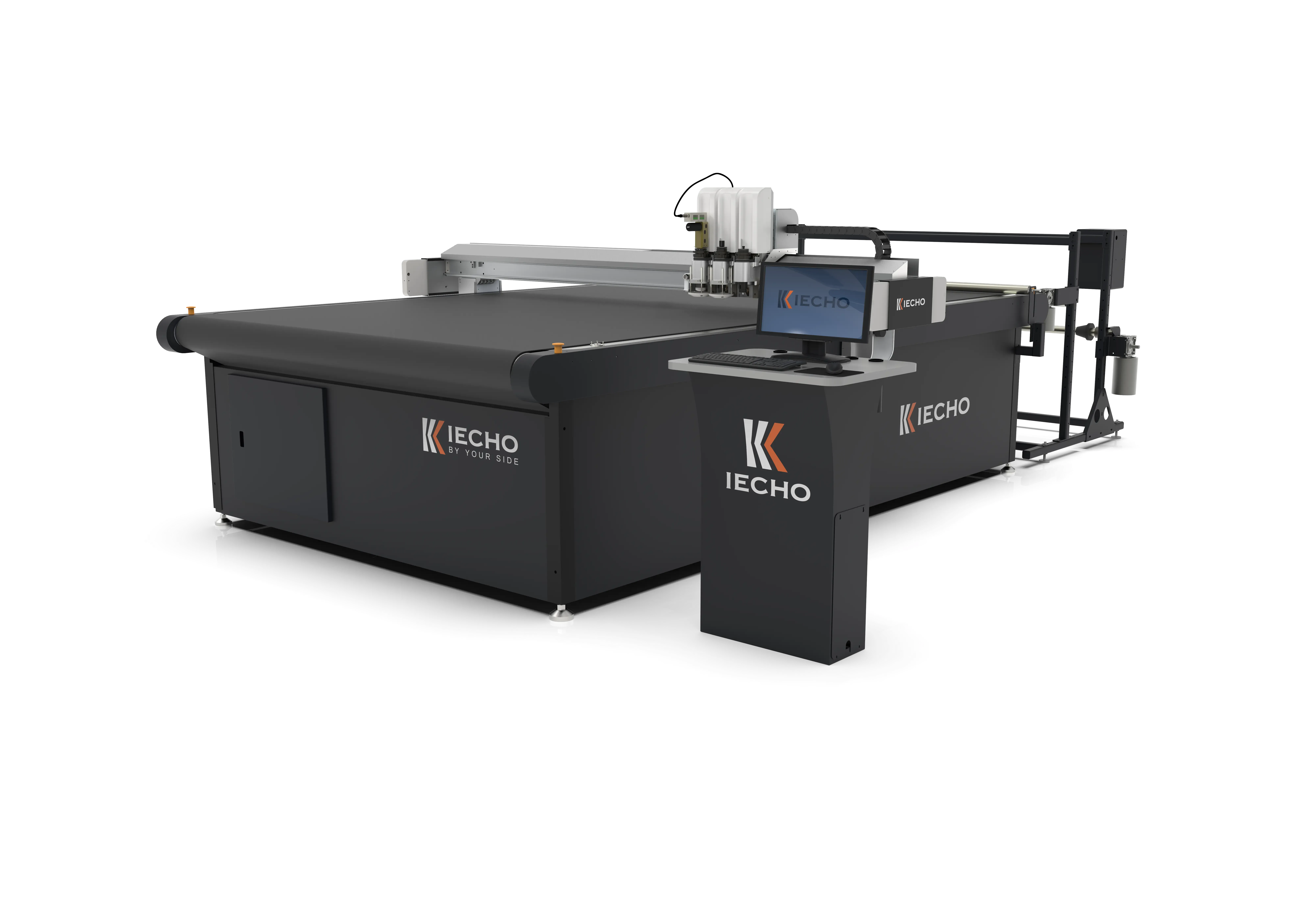
Most digital flatbed cutters on the market focus on cutting capability alone — blade types, cutting depth, and speed. The IECHO BK3 High Speed Digital Cutting System takes a different approach: it is engineered as a complete automated production system, where feeding, cutting, and collecting work together as a single continuous workflow with minimal manual intervention.
The BK3 can perform through cutting, kiss cutting, milling, punching, creasing, and marking with high speed and high precision. With its integrated stacker and collection system, it handles material feeding and collecting automatically — making it suitable not just for sample making and short runs, but for mass production in signs, advertising printing, and packaging industries.
At a maximum cutting speed of 1.5 m/s — 4 to 6 times faster than manual cutting — the BK3 is in a performance class designed for shops where the cutter needs to keep pace with high-volume print output, not create a bottleneck at the finishing stage.
Technical Specifications: What the BK3 Delivers
The IECHO BK3 is available in multiple working width configurations to suit different production floor requirements. All variants share the same core automation systems, aviation aluminum table construction, and cutting head technology. The table below covers the key technical specifications:
| Specification | BK3 |
|---|---|
| Max Cutting Speed | 1.5 m/s (4–6× faster than manual) |
| Table Construction | Aviation Aluminum with Regional Air Suction |
| Vacuum Control | Frequency Conversion System (area on/off) |
| Cutting Functions | Through Cutting, Kiss Cutting, Milling, Punching, Creasing, Marking |
| Feeding System | Automatic Sheet Feeder + Conveyor |
| Collection System | Automatic Collecting Table |
| Positioning System | High Precision CCD Camera (Auto-Registration) |
| Knife Initialization | Automatic (Displacement Sensor) |
| Cutting Mode | Continuous Cutting (Long Pieces Supported) |
| Production Type | Sample Making, Short Run & Mass Production |
| Industries | Signs, Advertising Printing, Packaging |
Note on the Aviation Aluminum Table: The BK3’s aviation aluminum construction provides a flat, rigid, and lightweight work surface that resists warping under continuous production heat and load. Regional air suction — where individual vacuum zones can be turned on or off independently — concentrates suction power exactly where the material is, reducing energy waste and improving hold-down on smaller or irregularly shaped sheets.
Three Core Capabilities That Define the BK3
The IECHO BK3 is built around three engineering pillars that together make it a production-class system rather than a stand-alone flatbed cutter.
1. Fully Automated End-to-End Workflow
The BK3’s automation workflow runs in three stages without operator intervention between each: material is sent to the loading area by the sheet feeder, fed to the cutting area via the automatic conveyor system, and after cutting, materials are sent directly to the collecting table. This fully automated sequence minimizes manual intervention throughout the production run — a fundamental advantage for shops running high-volume, repetitive cutting jobs where operator labor is the primary throughput constraint.
2. Aviation Aluminum Table with Regional Vacuum
The BK3’s table is constructed from aviation-grade aluminum and equipped with a regional air suction system. Individual vacuum zones can be activated or deactivated independently, directing full suction power to the active cutting area. Vacuum intensity is managed by a frequency conversion system, allowing precise control of hold-down force across different material weights and types. This translates directly to more consistent material hold-down during high-speed cutting passes — especially on lighter or smaller-format sheet materials that can shift on conventional open-zone vacuum tables.
3. 1.5 m/s Cutting Speed
The BK3’s cutting heads achieve a maximum speed of 1.5 m/s, which IECHO positions as 4 to 6 times faster than manual cutting. For production shops finishing large print runs, this speed advantage translates directly into more jobs completed per shift — or the ability to bring cutting in-house at a pace that matches high-volume wide-format print output without the BK3 becoming a production bottleneck.
Production tip: The BK3’s continuous cutting mode allows it to handle long pieces that exceed the table length by feeding material through incrementally. For packaging shops producing long corrugated blanks or sign shops cutting banner-length prints, this eliminates the need to pre-cut material to table size before finishing — saving material handling time on every long-format job.
Four Intelligent Systems Built Into the BK3
Beyond its core cutting capability, the IECHO BK3 integrates four intelligent systems that automate the most time-consuming and error-prone steps of a digital cutting workflow.
Vacuum Section Control System
BK3 suction areas can be turned on and off individually to create a dedicated working zone with concentrated suction power and less energy waste. The vacuum power is controlled by a frequency conversion system, allowing precise adjustment of hold-down force based on material weight, sheet size, and cutting speed — ensuring consistent material stability throughout the entire production run.
IECHO Continuous Cutting System
IECHO’s intelligent conveyor system integrates feeding, cutting, and collecting to work simultaneously as one continuous operation. Continuous cutting mode supports long pieces that exceed the table length, eliminating the need to pre-cut long material and saving significant labor cost. Productivity increases because the machine keeps running between pieces rather than waiting for manual reloading.
IECHO Automatic Knife Initialization
The BK3 controls cutting depth accuracy through a displacement sensor that automatically initializes the knife to the precise depth required for each material. This eliminates the manual trial-and-error blade depth adjustment that wastes material and time on conventional flatbed cutters — and ensures consistent cut depth from the very first piece of every job, whether cutting thin self-adhesive vinyl or thicker corrugated board.
Precise Automatic Positioning System (CCD)
With a high-precision CCD camera, the BK3 realizes precise automatic positioning and registration cutting for different materials. It directly solves two of the most common problems in print finishing: manual positioning deviation (operator error) and print deformation (where printed graphics shift slightly from their expected position). The CCD system reads registration marks and adjusts the cutting path to match the actual printed position — regardless of slight print or media variation.
Who Should Invest in the IECHO BK3?
The BK3 is positioned for signs, advertising printing, and packaging businesses that need a cutter capable of both short-run sample production and sustained mass production runs. Here is where it makes the strongest business case:
Sign shops producing high volumes of contour-cut vinyl graphics, stickers, banners, and display materials benefit directly from the BK3’s 1.5 m/s cutting speed and automated feeding workflow. The CCD auto-positioning eliminates manual registration between prints, and the collecting system keeps the output organized without operator handling between pieces — enabling one operator to manage production runs that would otherwise require two or three.
Packaging businesses cutting corrugated board, grey board, and box blanks for short-run and mass production orders benefit from the BK3’s punching and creasing capabilities alongside through cutting. The automatic knife initialization ensures consistent cut depth across board thickness variations, and the continuous cutting system handles long corrugated blanks without pre-cutting — reducing material waste and labor at every stage.
For studios and print service providers producing design samples, prototype packaging, or short-run custom-cut printed pieces, the BK3’s multi-function capability — through cutting, kiss cutting, milling, punching, creasing, and marking on a single platform — eliminates the need for multiple specialized machines. The CCD registration ensures the first sample off the BK3 is production-accurate, not a calibration test piece.
Large-format printing operations that currently outsource cutting or use slower manual methods will find the BK3 transforms their finishing capacity. At 4–6 times the speed of manual cutting, with automated material handling reducing operator dependency, the BK3 enables finishing to keep pace with even the fastest wide-format print output — bringing the entire production workflow under one roof.
Final Verdict: Strengths and Honest Limitations
After a thorough review of the IECHO BK3’s engineering, automation systems, and production capabilities, here is our balanced assessment of who this machine is right for — and where its limitations lie.
Strengths
- Maximum cutting speed of 1.5 m/s — 4 to 6 times faster than manual cutting, enabling production-scale output
- Fully automated feeding, cutting, and collecting workflow minimizes operator intervention throughout the production run
- Aviation aluminum table with regional vacuum suction delivers superior material hold-down and energy efficiency vs conventional open-zone tables
- Frequency conversion vacuum control allows fine-tuning of suction power to match material weight and size
- Supports six cutting functions on one platform: through cutting, kiss cutting, milling, punching, creasing, and marking
- High-precision CCD camera eliminates manual positioning errors and compensates for print deformation automatically
- Automatic knife initialization via displacement sensor ensures consistent cut depth from the first piece — no trial-and-error setup
- Continuous cutting mode handles long pieces beyond table length without pre-cutting, saving labor and material
- Suitable for sample making, short run, and mass production — scales with business growth
- Available through Kelin Philippines with local technical support, training, and parts access
Limitations
- Production-class system requiring dedicated floor space for the table, sheet feeder, and collecting table configuration
- Full automation benefits require proper site layout — shops with constrained floor space may not realize the full workflow advantage
- CCD registration accuracy depends on print mark quality — poorly printed or misaligned registration marks will reduce contour cutting precision
- Initial calibration and IECHO software training required before full-speed production — budget time for proper onboarding
- Higher capital investment than entry-level flatbed cutters — best justified by shops with consistent high-volume cutting demand