Why the GCC Puma IV Is Built for Serious Sign Makers
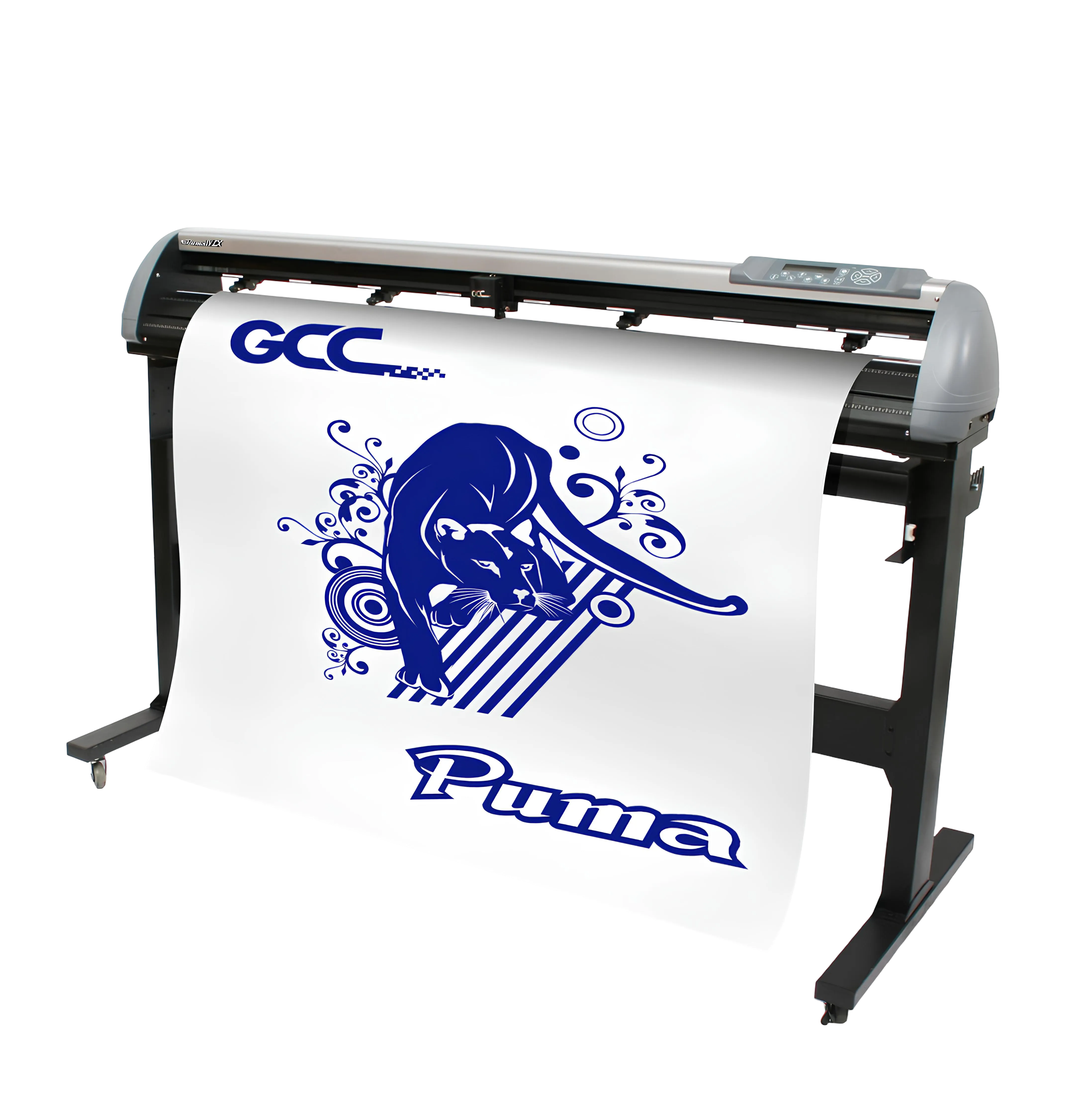
For sign shops and production houses that need to cut at volume without sacrificing accuracy, the GCC Puma IV Cutting Plotter is positioned as GCC’s high-performance answer: 1020 mm/s (40 ips) maximum cutting speed via a DC Servo Control drive motor, a 500g maximum cutting force, and the Enhanced AAS II Contour Cutting System for automatic registration mark detection on digital images.
GCC describes the Puma IV as delivering “unrivaled precision, speed, and unwavering reliability through a digitally controlled servo system, advanced contour cutting features, and robust connectivity” — making it an ideal solution for professional sign makers. Available in two models — P4-60LX (23.6"/600mm cutting width) and P4-132LX (51.18"/1300mm cutting width) — the Puma IV scales from desktop sign work to large-format vinyl graphics production.
The headline specification is the 1020 mm/sec cutting speed — more than 2.5× the speed of a typical 400 mm/s desktop cutter — combined with a DC servo motor that provides significantly more consistent speed and torque control throughout a cut path compared to stepper motor alternatives. For high-volume sign shops cutting long rolls of vinyl or complex contour shapes, this speed-and-control combination is where the Puma IV earns its position in the professional cutter segment.
Technical Specifications: Full GCC Puma IV Parameter Table
The GCC Puma IV is available in two models. All specifications below are taken directly from the official GCC Puma IV product brochure:
| Specification | P4-60LX / P4-132LX |
|---|---|
| Machine Model | P4-60LX | P4-132LX |
| Max. Cutting Width | 600 mm (23.6 in.) | 1300 mm (51.18 in.) |
| Max. Cutting Length | 50 m (164 ft) |
| Max. Material Thickness | 0.8 mm |
| Max. Cutting Force | 500 g |
| Max. Cutting Speed | 1020 mm/sec (40 ips) at 45° direction |
| Motor Drive | DC Servo Control |
| Type of Command | HP-GL, HP-GL/2 |
| Voltage | AC 100–240V |
| Dimension | 220 mm × 879 mm × 258 mm |
Model Selection Note: The P4-60LX is GCC’s desktop-format Puma IV with a 600mm (23.6") cutting width, suited to sign shops that primarily cut narrower rolls of vinyl, HTV, and label stock. The P4-132LX extends to 1300mm (51.18") for large-format sign shops cutting wide-format vinyl graphics, vehicle wrap strips, and wide banner material. Both models share the same DC Servo motor, AAS II system, and full feature set — only the cutting width and media capacity differ.
What 1020 mm/s DC Servo Control Means for Your Sign Shop
Speed and motor type are the two most critical performance indicators for a professional sign-making cutter plotter. The GCC Puma IV leads on both fronts.
1020 mm/sec — Industrial Speed in a Sign Cutter Format
At 1020 mm/sec (40 ips at 45°), the GCC Puma IV cuts at a speed that most production vinyl cutters cannot match. For a sign shop cutting roll after roll of vehicle lettering, window graphics, or promotional decals, the Puma IV’s speed advantage compounds across a full production day — more jobs completed per shift, less machine downtime waiting for a cut to finish, and faster turnaround on same-day orders. GCC positions this as “best cutting performance with low investment cost” — delivering near-industrial throughput without industrial-machine pricing.
DC Servo Control vs Stepper Motor
The DC Servo Control motor in the Puma IV is a critical differentiator from stepper-motor-based cutters at this price tier. A servo motor uses closed-loop position feedback — the motor continuously measures its actual position and corrects errors in real time. This delivers more consistent speed and torque across a full-length cut, especially at high speeds and through direction changes. Stepper motors run open-loop — they assume every commanded step is executed perfectly. Under load or at high speed, steppers can lose steps and introduce cumulative cutting errors that servo motors do not. For sign makers cutting complex paths or long-run jobs, the servo advantage is real and measurable.
500g Maximum Cutting Force
The Puma IV’s 500g maximum cutting force is double the 250g limit of a typical compact desktop cutter. This higher force ceiling means the Puma IV can cleanly cut through thicker, denser vinyl, reflective sheeting, sandblast resist, and other tougher sign-making materials that lighter-force desktop cutters struggle with. At the same time, the Puma IV’s force range is adjustable for fine work on thin films and self-adhesive papers where too much force would leave unwanted cut marks on the carrier sheet.
Production tip: The Puma IV supports a maximum cutting length of 50 metres (164 ft) — a critical spec for sign shops running long banner strips, vehicle graphic panels, or high-volume roll-to-roll sticker production. At 1020 mm/sec with Section Cutting enabled, even a 50-metre job is processed in sections for maximum output quality without requiring manual re-feeding.
Six Features That Define the GCC Puma IV as a Professional Cutter
The GCC Puma IV includes six specific features that separate it from entry-level and mid-range cutters in everyday sign-making production.
Enhanced AAS II Contour Cutting (LX Models)
The Enhanced AAS II (Automatic Alignment System II) guarantees precise contour cutting by automatically detecting registration marks on digital images. For print-and-cut workflows producing car decals, custom vinyl signs, and food labels, AAS II eliminates manual registration and ensures the Puma IV’s cut path precisely follows the printed image outline — even when the printed media is not perfectly aligned on the cutting platen.
Segmental Positioning (LX Models)
Segmental Positioning corrects crooked prints for improved accuracy. When printed media feeds into the Puma IV at a slight angle — common with roll media that has minor edge curl or inconsistent tension — Segmental Positioning automatically compensates for the skew, ensuring the cut path remains accurately aligned to the print throughout the full length of the job. This feature is especially valuable for long-run jobs where a small angular error compounds significantly over the cut length.
Auto Rotation (LX Models)
Auto Rotation automatically detects the material feeding direction and rotates the cutting content based on unique registration marks. This allows the Puma IV to correctly process print-and-cut jobs regardless of how the printed sheet was loaded — portrait or landscape — without requiring the operator to manually rotate the cut file in software. For sign shops handling mixed-orientation print jobs, Auto Rotation removes a common source of cut orientation errors.
Section Cutting
Section Cutting divides long plot data into sectional outputs for higher cutting quality and increased precision. When cutting very long jobs — such as 50-metre banner strips or multi-metre vehicle graphic panels — processing the entire cut as a single continuous path can introduce cumulative mechanical errors. Section Cutting breaks the job into defined segments, resetting the reference position between sections to maintain accuracy and output quality throughout the full job length.
Ethernet Connection
The Puma IV’s Ethernet Connection enables efficient network operation, allowing multiple Puma IV units to be controlled by one PC or shared among multiple PCs on a network. For sign shops running more than one Puma IV in production, Ethernet connectivity eliminates the need for dedicated USB connections to each machine — the entire cutter fleet can be managed from a central workstation, dramatically simplifying production workflow and reducing cable clutter in the sign shop.
DC Servo Control Motor Drive
Unlike stepper-motor-driven cutters that run open-loop and are susceptible to step loss under high speed or load, the Puma IV’s DC Servo Control motor uses closed-loop feedback to continuously verify and correct its position in real time. This delivers consistent cutting accuracy at all speeds — including at the 1020 mm/sec maximum — and maintains torque and precision through complex curved paths and tight corner geometry that would cause a stepper-driven cutter to degrade in quality.
What the GCC Puma IV Is Built to Cut
GCC’s official application list for the Puma IV targets five core sign-making and graphic production use cases where its speed, force, and AAS II system provide a genuine production advantage:
Car decal production is one of the GCC Puma IV’s primary application targets. At 1020 mm/sec with a 500g cutting force and Enhanced AAS II for automatic contour detection, the Puma IV handles both solid-colour cut vinyl lettering and complex print-and-cut contour decals at the speed and precision professional automotive graphics shops require. The P4-132LX’s 1300mm cutting width accommodates wide vehicle graphic strips and side decals in a single pass.
For packaging producers and print finishing shops that need to cut custom box packaging die-cuts and folding carton shapes from printed vinyl or label stock, the Puma IV’s 500g cutting force and precise servo motor control handle the straight-edge and curved-path cuts required for packaging templates. Section Cutting ensures that even large multi-unit packaging cut sheets are processed accurately without positional drift across the sheet length.
Vinyl sign production — lettering, logos, storefront graphics, and custom-shaped decals — is the core use case the Puma IV is engineered for. At 1020 mm/sec, the Puma IV cuts vinyl lettering and sign graphics at speeds that allow a professional sign shop to process a full day’s queue of signage jobs without waiting on the cutter. AAS II contour detection handles print-and-cut vinyl decal jobs with automatic precision, eliminating the operator alignment time required by cutters without automatic registration.
Food label producers and custom sticker businesses running high-volume roll-to-roll cutting jobs benefit from the Puma IV’s combination of 1020 mm/sec speed, AAS II print-and-cut accuracy, and 50-metre maximum cutting length. For sticker and label rolls that require precise contour cutting around printed shapes, the Enhanced AAS II system automatically detects registration marks on each sheet and adjusts the cut path accordingly — delivering consistent contour accuracy across the full roll without operator intervention between sheets.
Final Verdict: Strengths and Honest Limitations
After a thorough review of the GCC Puma IV’s specifications, feature set, and target production applications, here is our balanced assessment for sign makers evaluating this machine.
Strengths
- 1020 mm/sec (40 ips) maximum cutting speed — more than 2.5× faster than typical 400 mm/s desktop vinyl cutters
- DC Servo Control motor provides closed-loop feedback for consistent accuracy at high speeds, superior to stepper-motor-driven alternatives
- Enhanced AAS II Contour Cutting automatically detects registration marks for precise print-and-cut without manual alignment
- Segmental Positioning corrects crooked media feeds for improved accuracy on angled or misaligned print-and-cut jobs
- Auto Rotation detects media feeding direction and rotates cutting content automatically based on registration marks
- Section Cutting divides long jobs into sections for sustained accuracy across up to 50-metre cuts
- Ethernet Connection enables multi-unit network control — multiple Puma IVs managed from a single PC or shared across multiple workstations
- 500g maximum cutting force handles thick reflective vinyl, sandblast resist, and dense sign-making materials beyond the reach of lighter-force desktop cutters
- Two model options: P4-60LX (600mm/23.6") for desktop production and P4-132LX (1300mm/51.18") for large-format sign work
- HP-GL and HP-GL/2 command compatibility ensures broad software support across all major sign-making and RIP software platforms
- Universal AC 100–240V input voltage works across all standard power environments without voltage conversion
- Available through Kelin Philippines with local technical support, demonstration, and parts access
Limitations
- Maximum 0.8mm acceptable material thickness — not suitable for thick board, foam, or rigid substrates requiring a flatbed cutting system
- Enhanced AAS II, Segmental Positioning, and Auto Rotation are LX-model features — confirm model variant when specifying the machine for contour-cutting workflows
- AAS II print-and-cut accuracy depends on consistent, well-printed registration marks — faded or misaligned registration marks will reduce contour precision
- Roller-type feeding; rigid sheet cutting on board or foam substrates requires a flatbed digital cutter (e.g., IECHO BK4 or TK4S)
- P4-60LX’s 600mm cutting width is suited to standard roll widths; sign shops needing to cut wider-than-1300mm panels in a single pass will require a different solution